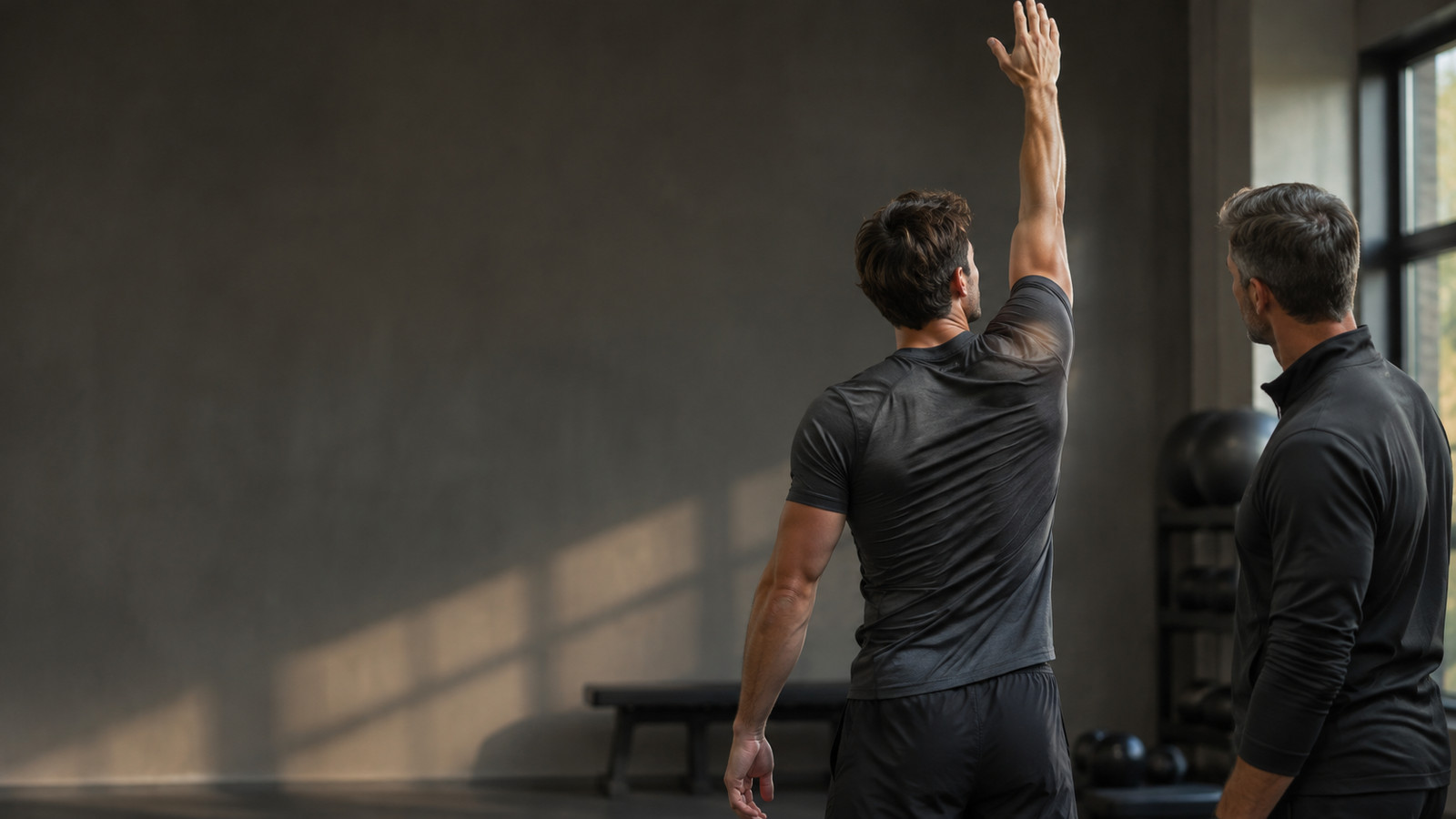
There is a familiar scene in almost every training environment. An athlete struggles to raise the arms overhead. The ribs begin to lift, the lower back extends, and someone watching concludes that the shoulders are tight. A few minutes later the athlete is stretching the lats, mobilizing the shoulder, or working against a resistance band.
Sometimes the movement improves. Sometimes it doesn't. Occasionally, the same athlete demonstrates excellent shoulder range of motion when lying on a treatment table. If the range is available in one position but disappears in another, what exactly were we trying to correct?
I have spent a considerable part of my working life examining differences like this. Not because shoulder mobility is unimportant, but because a movement is never the product of one muscle or one joint. An athlete may have sufficient passive range yet struggle to control a barbell overhead. Another may produce considerable strength at one joint angle and very little at another. Someone else may move differently from what a textbook suggests, without experiencing pain or any meaningful restriction in sport.
Those are not the same problem. Yet they are often given the same explanation, followed by a familiar collection of exercises.
I would rather begin with a less convenient question: what is the athlete being asked to do, and which part of that task is actually limiting them? The answer may be local to the shoulder. It may involve the position of the trunk or pelvis, the demands of balance, or simply the way the task has been organized. And sometimes the apparent deviation does not need correcting at all.
A shoulder movement is a relationship
The shoulder complex offers an extraordinary range of movement because several articulations contribute to what we see. The glenohumeral joint allows the humerus to move relative to the glenoid. The scapula moves against the thorax, and the clavicle changes position through the sternoclavicular and acromioclavicular joints. The rib cage and thoracic spine provide the changing surface and orientation against which the scapula operates.
The serratus anterior, trapezius, deltoid, rotator cuff, and larger muscles acting on the humerus contribute differently throughout the movement. During arm elevation, the scapula generally rotates upward and tilts posteriorly, but the amount and timing of movement differ among individuals.
For years we have taught scapulohumeral rhythm as though the shoulder should follow a reasonably fixed sequence. It is a useful teaching model. It is not a universal movement standard. A 2025 systematic review and multilevel meta-regression by Fernández-Matías and colleagues found substantial variation in scapular kinematics among people without shoulder pain and challenged the notion of a distinct early scapular setting phase or constant movement ratio [1].
This is worth taking seriously. We can identify a general anatomical relationship without expecting every athlete to reproduce one precise pattern. Sport, morphology, training history, movement speed, and the demands of the task can all change the visible result.
Scapular dyskinesis presents a similar problem. We may observe a prominent medial border, asymmetrical upward rotation, or one scapula moving differently from the other. Sometimes these findings accompany symptoms. They are also common in people without shoulder pain. Salamh and colleagues reviewed 2,365 individuals and reported scapular dyskinesis in approximately 48% of the asymptomatic population across the included studies [2].
The prospective evidence is not entirely consistent. Hickey and colleagues reported a relative increase in future shoulder-pain risk among asymptomatic athletes with dyskinesis, although the usefulness of this finding in isolation for screening was limited [3]. Hogan and colleagues subsequently found no statistically significant association between dyskinesis and future shoulder injury in their pooled analysis [4]. Different populations, screening methods, and outcomes matter here. Neither paper gives us a license to ignore scapular function, and neither justifies diagnosing dysfunction from appearance alone.
I still observe scapular movement carefully. I simply want it connected to something meaningful. Does the athlete have pain? Does control change under load? Is there a relevant injury history? Does the movement become more pronounced with fatigue? Is the athlete unable to produce force in the positions required by the sport? Without that context, an asymmetry can become a project that consumes time without improving the person in front of us.
The thorax changes the conditions
Consider the athlete who reaches overhead by lifting the rib cage and extending through the lumbar spine. We often call that a compensation for restricted shoulder flexion. Sometimes it is. But we have not yet established whether the missing range is at the glenohumeral joint, whether thoracic movement is limited, or whether the athlete simply uses that strategy because it makes the task easier.
Barrett and colleagues found that resting thoracic kyphosis was not consistently different between people with and without shoulder pain, while changing thoracic posture could influence measured shoulder range of motion [5]. That is an important distinction. A position may change movement without being the cause of pain.
I might first examine the athlete in a supported position, then standing, then under a manageable external load. I would compare active and passive range and watch how the scapula and thorax participate. If the arm reaches higher with the trunk supported, we have learned that the demands of support or body organization affect performance. We have not diagnosed weak abdominal muscles, tight lats, or dysfunctional breathing merely by observing that change.
I am equally cautious with the instruction to keep the ribs down during every overhead activity. It can be a useful cue when an athlete repeatedly relies on lumbar extension under load. It is not a universal rule for swimming, throwing, lifting, or hockey. The rib cage is allowed to move, and the thorax has to contribute to many athletic actions. My preference is to develop the ability to control different positions rather than teach one rigid posture as the answer.
The same caution applies to shoulder extension, which receives far less attention than overhead range. At the bottom of a dip, in a deep push-up, or during particular pressing variations, the humerus may move substantially behind the torso. Whether that range is useful depends on the exercise, anatomy, history, and load. A player with apprehension after instability should not be aggressively mobilized into anterior translation because the movement appears limited. Another athlete may have adequate passive extension but lack strength to control the loaded position. Changing the depth, hand position, or exercise may be more productive than chasing range for its own sake.
I am interested in usable range: the positions the athlete needs, can access safely, and can control under the required force.
A useful way to think about this is to distinguish the shoulder position from the position of the person performing the exercise. An athlete lying on the back with the knees bent may raise the arm while the trunk is supported and the pelvis relatively stable. Ask the same person to reach overhead while standing, and we have introduced the need to organize the entire body against gravity. Ask them to hold a weight overhead, and the force demands change again. The shoulder's passive range may be identical throughout these tasks while the quality of the active movement varies considerably.
There are also situations where I deliberately want to make a movement smaller. A player who feels discomfort near the bottom of a deep press may benefit from adjusting grip, range, or load while we investigate the cause. That is not admitting failure or avoiding rehabilitation. It is choosing a tolerable stimulus while retaining the opportunity to develop capacity. If the clinical assessment points to a meaningful limitation in extension, we may eventually train that range directly. If the range is already sufficient, making it larger is unlikely to be the central objective.
The same thinking applies to scapular positioning. A coach may ask an athlete to pull the shoulder blades down and back before pressing. That cue can be useful for a particular lift, but it should not become a rule for every shoulder movement. During natural overhead elevation, the scapula needs freedom to rotate and change orientation. Deliberately fixing it in one position may alter the task in ways that are neither necessary nor beneficial. The answer is not to abandon cues, but to understand which movement the cue is meant to improve and whether it does so.
Same shoulder, different body position
One of the most revealing adjustments in assessment is also among the simplest. Keep the arm movement broadly similar, but change the position of the body.
An athlete may reach overhead comfortably with both feet on the floor and struggle when asked to stand on one leg. The shoulder has not suddenly lost anatomical range. The base of support has changed, and the athlete now has to organize balance, pelvis, trunk, and reach together. Perhaps the center of mass moves differently. Perhaps a change in trunk rotation affects the position of the scapula. Perhaps the athlete is simply less familiar with the new task.
That observation can be useful without becoming a diagnosis. If the movement deteriorates in single-leg stance, it does not prove that the ankle causes a shoulder problem. It shows us that the task has changed. The next step is to understand which part of that change matters, if any.
This principle is supported by direct exercise research. Krause and colleagues compared resisted isometric shoulder external rotation performed standing, side-lying, and in a side plank. In 25 healthy recreational overhead athletes, average external-rotation torque was similar across conditions, while shoulder and trunk muscle recruitment differed [6]. A side plank may increase the contribution of surrounding musculature without necessarily increasing the external-rotation torque we measure.
Richardson and colleagues reached a related conclusion in a systematic review of kinetic-chain shoulder exercises [7]. Adding trunk and lower-body movement could alter recruitment around the scapula, but some comparisons favored more localized exercises when the objective was direct rotator cuff loading. In other words, whole-body integration is not automatically a stronger cuff exercise.
Research using fine-wire electrodes has also demonstrated that the activity of different regions of the supraspinatus and infraspinatus varies with the angle and plane of arm elevation [8]. A shoulder external-rotation exercise with the arm by the side is not mechanically identical to one performed in an elevated position. The contribution of muscle regions can change even when both exercises carry the same label.
This has changed how I think about progression. Supported external rotation may be appropriate when I want relatively controlled loading of the shoulder. Standing may be useful when the athlete needs to organize the movement with less external support. Tall-kneeling and half-kneeling can alter the base of support and the relationship between pelvis and thorax. Quadruped or plank variations introduce upper-extremity weight-bearing. The point is not that one position is easier and another automatically more advanced. A demanding side plank may place greater overall demands on the athlete than a standing cable exercise.
The choice should follow the question: which capacity am I trying to develop, and how will I know whether the exercise provides that stimulus? Changing position, resistance direction, arm angle, speed, or support can all be useful. Changing several variables simultaneously can also make it harder to understand why the result changed.
There is a practical way I would explore this with an athlete who reports difficulty reaching overhead, assuming the clinical history gives us no reason to avoid the task. I would begin with a comfortable bilateral stance, using a repeatable arm path and no meaningful external load. I might then compare a supported seated reach, a half-kneeling reach, and a standing reach with the weight shifted primarily toward one leg. Finally, I would return to the original position and introduce a modest, controlled resistance.
I would not call these five stages of rehabilitation. They are five ways of asking a related question. When we change the support surface or the base of support, are we also changing the athlete's ability to position the thorax and scapula? When resistance is introduced, is the limitation still one of range, or does the athlete simply lose the ability to maintain that range under load? Does the response remain the same when we repeat the task or change which leg is forward?
Suppose the athlete reaches comfortably with the back supported but elevates the ribs and shifts the pelvis when standing. It might be tempting to prescribe core stability work. But I would want to know whether this response is associated with actual force loss, pain, or an inability to perform an important sporting task. Perhaps the standing version is unfamiliar. Perhaps the athlete changes balance strategy when the arm is elevated. Perhaps the shoulder itself is not limiting the movement at all. We are still investigating.
The difference between an assessment variation and a training exercise is worth protecting. During assessment, I want to change relatively few variables at once so I can interpret the response. During training, I may deliberately combine several variables to create the sporting demand. A hockey player must eventually reach, rotate, see the ice, and manage forces while moving on skates. There is no reason to expect that task to be mechanically simple. But complexity belongs at the end of a line of reasoning, not automatically at the beginning.
I also consider how gravity acts relative to the arm. Side-lying external rotation with a dumbbell does not expose the shoulder to resistance in exactly the same direction throughout the range as a standing cable exercise. In prone work, the load acts through another orientation, and placing the arm at different elevations changes leverage and regional recruitment. A tall-kneeling press can reduce some lower-limb options while increasing the need to coordinate the pelvis and thorax. Weight-bearing through the hands introduces axial loading through the upper extremity, something a free-moving arm does not reproduce. The labels on the exercise sheet can remain familiar while the mechanics become quite different.
This is why I resist treating supported, standing, and closed-chain positions as a universal hierarchy. A poorly chosen side-plank variation may exceed what the athlete can currently manage, while a supported exercise may allow very substantial local loading. A position earns its place because of the adaptation we want or the question it helps us answer.
Strength depends on where and how we measure it
Muscle strength is often discussed as though it were a fixed number. Yet the force a muscle can produce depends partly on its operating length, and measured joint torque also reflects moment arms, neural activation, stabilization, and the conditions of testing.
This is particularly relevant when we compare shoulder internal and external rotation. A ratio measured with the arm beside the torso cannot simply be transferred to another arm position. An athlete may produce adequate force in the middle of the range and struggle near a position that matters more for their sport. We should be interested in that difference without immediately calling it a global weakness.
I have taken useful ideas from different schools of training, including Charles Poliquin's Structural Balance, movement-based approaches associated with Gary Gray, and broader systems thinking promoted by Paul Chek. Each directs attention toward relationships that might otherwise be overlooked. I would not treat any of their proposed standards as a complete explanation. Ratios are clues, not biological constants; movement variation is useful, but complexity does not make an exercise better; and anatomical connections are not proof that a distant structure causes pain.
The same principle applies to apparently tight lats, pectorals, or teres major. A muscle that feels stiff is not necessarily short, and the athlete may have enough passive range without sufficient capacity to use it under load. A force deficit measured in one position may reflect pain inhibition, leverage, or the way the athlete stabilizes the body rather than a single isolated muscle problem.
If a measurement is going to influence training, I want to know the angle, equipment, contraction type, and symptom response. I would much rather compare consistent tests over time than build a program around a strength ratio taken out of context. I also want to see whether developing a measured deficit changes anything during the actual movement.
It is useful here to return to basic mechanics. A muscle's active force-producing capacity varies with its operating length, while passive elements of the muscle-tendon unit can contribute more tension as length changes. At a joint, the measured torque also reflects the muscle's moment arm, the contribution of other muscles, the nervous system's ability to recruit them, and the stabilization available during the test. A force difference across two arm positions is therefore not a direct measurement of one muscle becoming stronger or weaker. It is a change in what the system can produce under those conditions.
This has consequences for structural balance testing. Imagine that we record shoulder rotation strength with the arm by the side, then repeat it with the arm abducted and the trunk supported differently. The relationship between internal and external rotation may change. The muscle lengths and moment arms have changed, and the stabilizing demands may be different. If an athlete's ratio falls outside a reference value in one position, that is information to examine. It is not, by itself, a diagnosis or an explanation for pain. And it is not evidence that the athlete must achieve a particular number before being allowed to train or compete.
There is another source of confusion: the difference between tension and the feeling of tightness. Athletes often describe a muscle as tight when they mean that movement is uncomfortable, difficult, or unfamiliar. That sensation may accompany reduced range, but it does not establish that the muscle itself is anatomically short. Pain-related guarding, neural sensitivity, joint structure, and passive tissue behavior can all contribute to the experience. Nor should we assume that a muscle which resists passive stretch is capable of producing high active force. Passive resistance and strength are different measurements.
The same considerations affect agonist–antagonist relationships. The pectoralis major and latissimus dorsi can generate substantial force during some movements, but their contribution changes with arm position. The trapezius and serratus anterior do not function as opposing switches, with one needing to be inhibited whenever the other is active. Scapular control is coordinated. An apparent dominance pattern may be an appropriate response to the task rather than a defect requiring correction.
These observations are part of why I remain interested in ideas from Poliquin's Structural Balance, Gray's movement work, and Chek's integrated approach without accepting any one of them as a complete system. Structural balance reminds us to look for meaningful capacity differences. Changing movement conditions reminds us that those differences are task-dependent. Broader assessment reminds us that the athlete is more than a joint. But none of those ideas removes the need to establish whether a finding is reliable, whether it matters, and whether an intervention actually helps.
When I retest an athlete, I want the same equipment, the same positions, and an understanding of normal measurement variation. Otherwise we may celebrate an improvement that came from changing the test. And after seeing a genuine strength improvement, I still want to know whether it can be expressed in the movement that led us to investigate the shoulder in the first place.
The sporting task decides what matters
The shoulder works differently in a swimming stroke, a baseball pitch, a volleyball spike, an overhead lift, and a hockey game. A swimmer must tolerate enormous repetition in overhead positions. A pitcher manages high angular velocities. A weightlifter stabilizes substantial external loads. A hockey player may spend much of the game below shoulder height, then suddenly absorb force through the arm during a fall or board battle.
For hockey, I am interested in how the shoulder performs while the player is skating, rotating, reaching with the stick, and preparing for contact. The arm may be held in a position that looks unremarkable in the gym, yet the combination of trunk rotation and an unexpected external load creates a very different task. A standing flexion screen may tell us that range is available; it cannot establish readiness for those forces.
This is where a broad assessment can become practical. If a player is comfortable in supported testing but develops symptoms during a rotational stick movement, I want to examine what changes. Is the limitation strength at a particular arm angle? Is the player apprehensive in a position related to previous injury? Does the load accumulate across practice? Does the movement change when the player needs to look in another direction?
I do not need every answer to come from a research paper before considering it. Experienced observation can suggest useful hypotheses. But I do need to distinguish a hypothesis from something demonstrated, and I want the intervention tested against a meaningful outcome.
I think this is especially important for athletes whose sport demands are not well represented by common shoulder screens. A swimmer may show excellent overhead range yet struggle when the same movement is repeated thousands of times across the training week. A throwing athlete may be powerful in a controlled gym exercise but lack force or control during a particular phase of the throw. A hockey player may seldom need maximal elevation in ordinary play but may experience the greatest shoulder forces while the arm is unexpectedly displaced during contact.
Those examples also remind us to separate a movement that is limited by the shoulder from one that is limited by the task. A player reaching with the stick while rotating the trunk might appear to lose shoulder range when the pelvis turns or the feet change position. The arm's absolute position in space may change even when the glenohumeral movement remains similar. The opposite can occur when a player creates apparent reach by rotating the trunk rather than moving farther at the shoulder. Neither pattern automatically represents a problem, but each affects how we interpret what we see.
Foot position deserves a place in this investigation, particularly for exercises performed standing. Altering stance may change how the pelvis and thorax organize themselves, which changes the arm's starting orientation. But a standing assessment in training shoes cannot by itself explain shoulder performance while skating. The skate boot, blade, ice contact, and the player's skating skill create another set of constraints. When the claim concerns hockey performance, I want the final observation to include hockey performance.
From observation to a decision
My assessment begins with the athlete's history. Is the concern pain, instability, reduced range, weakness, or an inability to perform a specific action? Did symptoms begin after trauma or develop gradually? Are they present in ordinary activity, in the gym, during sport, or only after repeated exposure?
A significant traumatic event, suspected structural injury, instability, neurological signs, or other concerning findings requires appropriate clinical assessment. The 2025 guideline for rotator cuff tendinopathy supports a thorough history, relevant examination, strength and movement assessment, and consideration of the cervical spine [9]. Importantly, that guideline addresses tendinopathy and partial-thickness tears; it is not a rehabilitation guideline for a full-thickness rupture or postoperative repair.
Once the presentation is understood, I look at active and passive movement, then at what changes with support, load, joint position, and task complexity. A person who cannot actively reach a position but can achieve it passively presents a different question from someone whose range is limited in both conditions. Pain, apprehension, or force production may influence the result. A shoulder that performs well at one angle but fails under relevant load deserves a position-specific strength examination, not automatically more stretching.
Finally I return to the original problem. If the movement matters in a press, we examine the press. If it matters while swimming or throwing, we examine those demands. If the limitation appears during hockey contact, the athlete eventually needs to be evaluated against appropriate contact-related demands within the clinical constraints.
This requires judgment. Not every apparent asymmetry is a target, and not every improvement in a screening test deserves time in the program. The athlete may need direct cuff strengthening, a change in available range, greater trunk control, or simply a more suitable version of the exercise. The objective is to identify what limits performance and develop that capacity, then demonstrate that the change is useful.
Consider a hypothetical player whose shoulder feels restricted during a landmine press but who has comfortable overhead range when the trunk is supported. It would be easy to prescribe mobility work because the pressing movement looks limited. I would prefer to keep the original press as our reference task, then investigate whether the result changes when we adjust the load, stance, trunk rotation, or angle of pressing. If a modest reduction in load restores the movement without symptoms, local force capacity or how the player manages the load becomes a reasonable hypothesis. If the movement remains painful regardless of load, the clinical assessment becomes more important. If the difference appears only when the player rotates or shifts weight, we may need to examine whole-body coordination.
The intervention might be surprisingly ordinary. Direct strength work at a relevant angle, a supported variation to develop force, or a better-tolerated press while the player maintains necessary training exposure. We do not need to invent an elaborate corrective program simply because several systems influence the movement. The plan should be based on the limitation we can reasonably identify, not the number of anatomical relationships we can describe.
I would also expect the picture to change during a development period. A task that was initially useful as an assessment may become a training exercise. As the player gains strength, we can introduce greater speed, different arm positions, and more complicated interactions with the trunk. We should also be prepared for the possibility that the original pattern remains visible while performance and tolerance improve. At that point I would question whether changing the appearance of the movement is still a worthwhile objective.
The larger issue is transfer. If a player becomes better at a particular exercise but remains unable to tolerate a relevant demand during skating or contact, our work may be incomplete. It is not necessarily wrong; strength and capacity take time to develop. But the next stage must bridge that gap rather than assume that improvement in the gym automatically guarantees readiness for sport. That is where the assessment article ends and the return-to-play problem begins.
The point of looking beyond the shoulder
There is nothing wrong with observing scapular movement or assessing posture. The mistake is allowing the appearance of a movement to become its explanation before we understand the task.
The shoulder is part of a larger mechanical system, but that does not mean every shoulder symptom originates in the pelvis, spine, or foot. Connections are worth exploring when they help us ask better questions. They are not reasons to abandon local assessment or direct strength training.
After decades around athletes, I have become less interested in making every movement look alike and more interested in understanding where a particular athlete possesses useful capacity and where that capacity becomes limited. Some differences require development. Others are simply variations of normal movement or adaptations to sport.
The shoulder doesn't work alone. Neither should our reasoning about it.
Scientific References
- Fernández-Matías, R., et al. (2025). Scapular kinematics variability in individuals with and without rotator cuff-related shoulder pain: A systematic review with multilevel meta-regression. Brazilian Journal of Physical Therapy, 29(6), 101261. https://doi.org/10.1016/j.bjpt.2025.101261
- Salamh, P. A., et al. (2023). Is it time to normalize scapular dyskinesis? The incidence of scapular dyskinesis in those with and without symptoms: A systematic review of the literature. International Journal of Sports Physical Therapy, 18(3), 558–576. https://doi.org/10.26603/001c.74388
- Hickey, D., et al. (2018). Scapular dyskinesis increases the risk of future shoulder pain by 43% in asymptomatic athletes: A systematic review and meta-analysis. British Journal of Sports Medicine, 52(2), 102–110. https://doi.org/10.1136/bjsports-2017-097559
- Hogan, C., Corbett, J.-A., Ashton, S., Perraton, L., Frame, R., & Dakic, J. (2021). Scapular dyskinesis is not an isolated risk factor for shoulder injury in athletes: A systematic review and meta-analysis. American Journal of Sports Medicine, 49(10), 2843–2853. https://doi.org/10.1177/0363546520968508
- Barrett, E., O'Keeffe, M., O'Sullivan, K., Lewis, J., & McCreesh, K. (2016). Is thoracic spine posture associated with shoulder pain, range of motion and function? A systematic review. Manual Therapy, 26, 38–46. https://doi.org/10.1016/j.math.2016.07.008
- Krause, D. A., et al. (2018). Influence of body position on shoulder and trunk muscle activation during resisted isometric shoulder external rotation. Sports Health, 10(4), 355–360. https://doi.org/10.1177/1941738118769845
- Richardson, E., et al. (2020). Role of the kinetic chain in shoulder rehabilitation: Does incorporating the trunk and lower limb into shoulder exercise regimes influence shoulder muscle recruitment patterns? Systematic review of electromyography studies. BMJ Open Sport & Exercise Medicine, 6(1), e000683. https://doi.org/10.1136/bmjsem-2019-000683
- Whittaker, R. L., Alenabi, T., Kim, S. Y., & Dickerson, C. R. (2022). Regional electromyography of the infraspinatus and supraspinatus muscles during standing isometric external rotation exercises. Sports Health, 14(5), 725–732. https://doi.org/10.1177/19417381211043849
- Desmeules, F., et al. (2025). Rotator cuff tendinopathy diagnosis, nonsurgical medical care, and rehabilitation: A clinical practice guideline. Journal of Orthopaedic & Sports Physical Therapy, 55(4), 235–274. https://doi.org/10.2519/jospt.2025.13182
Magnus Ågren
Hockey Performance Leadership & Player Health
I build hockey clubs’ performance systems, keep them working, and connect the people who run them.
People. Purpose. Performance.