Three departments. No shared truth.
One player. One week. Three different reads on what ready actually means. The gap between them is where decisions get made by default.
You usually feel it before you can name it.
The season rarely breaks in one moment. It slips through decisions nobody was clearly designed to own.
Magnus Ågren helps elite hockey clubs connect coaching, medical, performance, and athlete development into a decision structure that holds when pressure rises.
You already know which game it was. You know which conversation did not happen before it.
It is what happens between them.
You already have strong people. Coaching. Performance. Medical. Each may be doing the job properly — but inside its own logic, with its own language, and its own definition of what ready actually means.
You can give three departments the same data and still get three different decisions. Data does not decide. People do. Without a shared structure, good people interpret pressure differently.
Nobody was wrong. Nobody was talking. The structure was not clear enough when pressure arrived.
One player. One week. Three different reads on what ready actually means. The gap between them is where decisions get made by default.
The most important calls get made informally — because the structure underneath them is too weak to hold when it matters.
Three different answers from three different people. He starts managing himself — his load, his readiness, his risk. When an athlete has lost trust in the structure around him, he becomes his own worst decision-maker.
Someone already sees the risk. But if the structure does not protect that voice when competitive pressure is loudest, the answer often stays in the room.
I have been the S&C coach who found out a player was injured when he walked into the gym — not from anyone on staff. I have been the performance director who built something over three years and watched it dismantle in a week. The pattern is always the same. The thing that breaks first is never the result. It is the trust inside the room.
The pattern does not change until the structure underneath it changes.
What feels like isolated situations in October becomes patterns by January. Outcomes by March.
It shows up in availability, in decisions that should have been simple, and in the trust a player has in the people around him. Once that trust is damaged, the room feels it.
He said he felt fine. You played him. Three weeks later you are explaining it to the board.
When coach, physio, and performance give different signals, the athlete becomes the final interpreter of his own risk. That is not athlete autonomy. It is an organisational gap.
By Thursday the plan you agreed on Monday no longer exists.
No shared rhythm means the reactive call steers the plan. By Friday you are managing consequences, not executing a competitive strategy.
Someone in that room already knew. Nobody said it.
It is already in the room. But when the structure does not protect the person who holds it, competitive pressure takes over and the answer stays quiet.
Every season you start the same conversation you had the season before.
The last game ends and the knowledge walks out with the staff who leave — or gets buried in a review that looks for mistakes instead of clues. Development does not compound. It restarts.
You have had this conversation with the board. You will have it again. The staff has not changed.
When the architecture around good people stays unchanged, the outcomes stay unchanged. More effort goes in. The same fractures reopen. The problem was never the people.
You did not lose it in one night. You lost it in October and did not know until January.
Not in one moment. In fifty small ones nobody owned. By the time it is visible, February is already decided.
This is not a personnel problem. It is a structure problem — and the fix looks completely different.
If the pattern sounds familiar — the next step is simpler than most expect.
Built for the reality of your club. Not a template.
No pitch. No deck. A direct diagnostic of where your structure is actually breaking — and whether this work is the right fit. You leave knowing more about the real problem than when you arrived.
Whether the gap sits at alignment level, method level, or full system level — you receive a clear diagnosis in writing. The problem is named and owned before any work begins.
When that moment arrives — the coach asks, the physio says the same thing, the player already knows — the system is working. That is what the work is built to produce.
The first conversation is a diagnosis, not a pitch. Response within 48 hours.
The head coach still leads. The medical team still protects. Performance still drives. The difference is what connects them.
Not more meetings. Not another process document that dissolves in October. What changes is what decisions are built on when pressure arrives and there is no time to debate the basics.
The head coach still makes the call.
Readiness, risk, progression, and return-to-play stop being separate departmental opinions. They become one shared frame the whole club reads from.
The weekly meeting still happens.
The same people may be present, but now the right information arrives at the right time, in the same language, with ownership that is clear before urgency takes over.
The player still asks the question.
One voice. One message. No corridor version, no gym version, no treatment-room version. Trust rises because the answer holds wherever he asks it.
The data may stay the same.
Shared data does not create shared decisions. A real operating structure does. The difference is not what the club measures — it is how the club decides.
Staff changes still happen.
Decision rights, language, thresholds, and operating rhythm are no longer held in one person's head. The club keeps what it has learned.
Pressure does not disappear.
That is the point of architecture. Not to look organised in September, but to still be coherent in February when most clubs are running on noise.
Most clubs already know something is off. The harder question is where exactly.
One of these will feel uncomfortably familiar. That is where the work starts.
Credible people. Real effort. No single version of ready.
The same player gets three different answers depending on who he asks first. Each department is working inside its own logic, its own language, and its own definition of what fit actually means. The corridor is making the calls that the structure should be making — and everyone knows it but nobody owns the fix.
One shared definition of ready. One decision rhythm per week. One voice to the player — before the corridor decides for you. Alignment that holds under pressure, not just in the meeting room.
Hard training. Real investment. Growing uncertainty about whether it is pulling in the right direction.
The daily methods are serious but a quiet question has opened: does this actually serve the way your club wants to compete? The data exists. The interpretation of it does not align across coaching, performance, and medical. Effort without a clear north produces results that cannot be built on — only explained away.
Methods, loading, testing, and return-to-play logic reviewed against your actual competitive identity — not a generic template. The work starts pulling in one direction. Staff have a shared framework to read from, not competing systems running in parallel.
The problem has survived two coaching changes. It is not a people problem.
The issue is no longer about individual decisions. It is about the structure those decisions sit inside — who holds authority, how information moves between departments, what survives a coaching change, and what disappears with the person who carried it. There is no shared operating manual. When a key person leaves, the system leaves with them. The club starts over. Again.
A performance system built to outlast any single person in it. Decision rights documented. Authority protected in writing. A shared operating manual the whole staff works from — so the next staff transition does not reset what took three years to build.
The information is already in your building. What is missing is not effort. It is structure.
One organisation per league and time.
If the more immediate need is applied performance work inside the training environment —
Performance Development →
Most clubs feel the gap before they can name it.
Five questions. Ten minutes.
A clear read of exactly where your system is breaking.
Answer honestly — not how things should work, but how they actually work when pressure is highest. The pattern in your answers will tell you more than most consultants will after three meetings.
Download the diagnostic — freeNo form. No email required. Just the questions.
When a player's readiness is unclear, who makes the final call — and does everyone already know that?
Is there a fixed moment every week when coaching, medical, and performance see the same information at the same time?
If your Head of Performance left tomorrow, what would be lost that is not written down anywhere?
Three decades. Multiple leagues. Olympic cycles. The pattern that breaks organisations is the same everywhere. So are the outcomes when the structure finally holds.
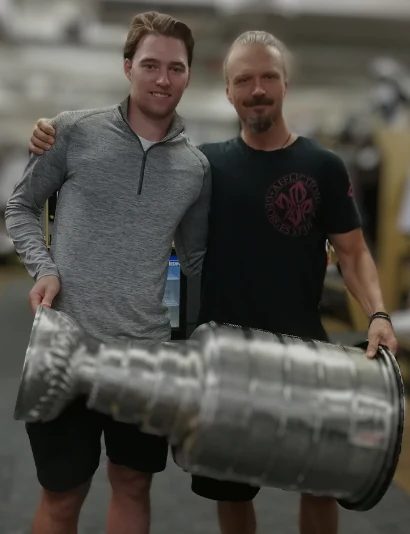
Brynäs IF · Swedish Championship Final. The season that showed what the structure can produce when it holds. Coaching, medical, and physical preparation reading from the same frame, all the way to the end. The result is never guaranteed. But the conditions for it can be built. That is what this work is built toward.
Stefan Nystrand set two short course world records in Berlin in 2007 — the 100m freestyle in 45.83 and the 50m freestyle in 20.93. The work that preceded those records was not sprint-specific programming. It was the physical and structural preparation that allowed him to arrive in Berlin capable of them. That distinction matters.
Ex. General Secretary · Swedish Ice Hockey Association
"Magnus always pushes himself to further his knowledge — to evolve himself and the players. I always had a great time discussing training with him, and learned a lot." A very good colleague and friend. The depth of thinking he brings to performance work is not common at any level of the game.
Ex. Head Coach · Swedish Championship · Brynäs IF
"Magnus is very well educated, knowledgeable and meticulous in his profession. He is always up to date and well read in his area of expertise, which makes you feel a great deal of trust in him." His knowledge and ability create great results for his athletes. He is also very cooperative and a warm person, whom I can greatly recommend.
Additional references and recommendations are available on LinkedIn.
View LinkedIn recommendationsIn professional hockey, a wrong decision in November costs you February. There is no second quarter to recover in. No board meeting to defer to. The consequence arrives before the conversation does — and the organisation that survives is the one that built the structure before the pressure came.
An Olympic cycle is four years. A hockey season is eight months. The timelines are short, the consequences are public, and there is no version of "we will fix it next quarter." The decision architecture that survives these conditions is not complex. It is disciplined. That discipline is what this session is about.
The most expensive leadership mistake is hiring excellent people and then building a structure that prevents them from doing excellent work. They stop speaking up. They stop flagging what they actually see. The information that could protect the organisation stays quiet because the environment did not make it safe to say it. Elite sport learned this the hard way — repeatedly. This session shows what it took to fix it, and what your organisation can build before it costs you.
In sport, the coach changes. The captain changes. The medical director changes. The clubs that compound over time are not the ones with the most stable rosters — they are the ones with the most dependable architecture beneath the people. That architecture is what makes knowledge institutional rather than personal. It is what makes the next leader effective from day one instead of year two.
These are not sport analogies applied to business. This is operational thinking from environments where the cost of structural failure is immediate, visible, and measured in results that end careers. The relevance to your organisation is not the sport. It is the speed, the stakes, and the question of whether what you have built holds when you are not in the room.
Keynote · Half-day workshop · Leadership team session · Executive retreat
Thirty-five years of watching the same pattern. It is never the player.
The experience on this page pre-dates the career of many of the GMs and Sporting Directors reading it. That is not a boast. It is context for what you are actually talking to.
Athlete. Coach. Every role between a junior gym and a head of performance seat at a senior SHL club. The person on the wrong side of a conversation that should never have happened — because the structure had not been built to prevent it. And the person expected to hold the line when the boardroom was watching and results could not wait.
Every role. Every side of the table. Every version of the conversation where someone had the information and said nothing because the structure did not protect the person who held it. That is where this work started — not in a theory, but in a specific moment watching a specific player fall through a gap nobody had designed.
The same structural failure appeared in every environment this work has touched — different leagues, different countries, different levels of resource. Hockey clubs in four leagues. Olympic programmes across five cycles. Corporate organisations with none of the sport context but identical patterns underneath. The gap between departments is not a hockey problem. It is what happens when competent people operate without a shared frame. Recognising that pattern repeat is clarifying. The gap is always structural. The fix always starts in the same place.
Seven seasons in the SHL. The most instructive period in this career — not because everything went well, but because everything that can disrupt performance work happened during it. But what came out of those years was not primarily a record of results. It was the seasons where they were not — and what that taught about the difference between a system that holds and one that only looks like it does.
When the mandate is not protected in writing, a single staff change dismantles in days what took years to build. When performance is not genuinely part of the competitive philosophy — not just staffed for it, but built into how the club thinks — the department becomes a service function that nobody truly listens to under pressure. When the shared vision lives in one person rather than in the club itself, it leaves when that person does. These patterns appear in every league. They are why the work always begins with a diagnostic not only of the problem — but of whether the right conditions exist to actually address it.
There is a version of this that the player experiences directly and rarely names. He stays at a club for four or five years. In that time the coaching staff changes, the medical lead changes, the performance team changes. Each new arrival brings different methods, different language, a new testing philosophy. The player adapts. He does what is asked. But nobody owns the thread of his development across those transitions. He ends up knowing less about his own body and trajectory in year four than he did in year one — not because the people were bad, but because nobody was responsible for the continuity. A system that outlasts staff changes protects the player from that experience. He is the one who ultimately pays for every structural failure in the building.
The practitioners who last are the ones who are still curious. Still reading. Still willing to sit at the back of a conference and listen to someone half their age present something they have never considered. The dangerous ones are the ones who stopped — who deliver their system confidently while the field moves around them without noticing.
That curiosity, sustained over a career, produces a breadth a single specialism cannot. Physical preparation is the foundation — but the work has always run into nutrition, rehabilitation protocols, the mental side of returning from injury, and the psychology of sustained performance under competitive pressure. Beyond the club work, businesses were built and scaled — training facilities that had to function as organisations. Supplement development that required understanding human physiology at a level where opinion is not enough. Leadership consulting for companies outside sport facing structurally identical problems with different terminology. The question underneath all of it has always been the same: what does a person, or an organisation, actually need to perform — not in the best conditions, but in the ones that actually arrive?
At the final stage of a senior recruitment — for a Head of Performance, a lead physiotherapist, a Performance Director — there are questions that reveal everything and questions that reveal nothing. After thirty-five years you know which is which. That knowledge is available. Not as a standard service, but when the fit is right and the stakes are high enough to warrant it.
For practitioners navigating those environments from the inside — Practitioner Mentorship →
The goal of every engagement is to not be needed for the same problem twice. A club that is structurally stronger in year three than it was in year one — not because the people changed, but because the architecture finally held.
The turning point is rarely better effort. It is usually better architecture.
The architectural work and the applied performance work come from the same thinking. Some clubs need the structure. Some need the methods. Some need both — at different points in the same season.
Performance Development →Across clubs, leagues, and years. The same standard held.
Hockey Consultant · Retired Professional · HC Fribourg-Gottéron · Swiss NL · 2018 Olympian
"At Brynäs I watched him blend science and practice in a way most performance staff talk about but never execute." He is truly unique in his continued education and in blending old and new techniques to push the boundaries of performance. He pushes the boundaries without losing the player. That is a rare combination at this level.
Pro Scout · Columbus Blue Jackets · NHL · Former Professional, Brynäs IF · Düsseldorfer EG
"In fifteen years as a professional hockey player, he is the benchmark I measure every performance environment against." Magnus is always furthering his education in all aspects of strength and conditioning — which in return not only helps individual players but the overall team. I met him at Brynäs in 2016 and I will continue to consult with him beyond my playing career.
Retired Professional · SHL · KHL · DEL
"I played hockey for 10 years in Europe and there was no one even close to as good a trainer as Magnus. When I was traded I continued to use his programme throughout the rest of my time in Sweden — and then in the KHL and DEL." We had 25–30 players with individual workouts. On top of that Magnus would spend time with each of us throughout the day to make sure everything was clear. Magnus is truly one of the best trainers in the game and any team would be lucky to have him.
Professional Hockey Player · Schwenninger Wild Wings · DEL
"The MD told me the rehab would take up to 12 months — and that maybe I could be back playing. Magnus took charge of my rehab, pushed and motivated me every day." Against all odds I played 7 months later, and I still do — better than ever. That does not happen without someone who understands both the body and the pressure of getting back.
Hockey Development Coach · Retired NHL Player
"He went far beyond what is generally expected — and you felt it in how the environment changed around you." His dedication was obvious. I always felt like he truly cared about outcomes, not just process. Any team or organisation would be lucky to have Magnus.
That usually means the club solved the wrong problem — or installed the right answer without protecting the authority underneath it. A binder does not hold when a coach wants a player on the ice and the medical staff say he is not ready. This work builds the mandate, not just the method.
Especially then. Good people in a weak structure produce expensive confusion. The stronger the staff, the more costly the misalignment when it is left unowned — because everyone assumes someone else is holding it.
Most clubs try. The attempt usually produces a document, a workshop, or a new meeting that holds for six weeks and then quietly returns to the previous pattern. The reason is not effort or intent — it is that the people building the system are also inside it. They cannot see the gaps they are standing in. Someone who has spent three decades watching the same fracture appear in different clubs, and who has no stake in the internal politics, sees something different. Not better. Just from outside the frame.
Neither by default. The work starts by clarifying the architecture around the people already there. Sometimes that reveals capability gaps. More often it reveals structure gaps first — and structure gaps are faster to fix than people assume.
A direct diagnostic. No pitch. No theatre. Your reality, your pressure points, and an honest read of whether the issue sits at alignment level, method level, or full system level. You leave knowing more about the real problem than when you arrived.
One organisation per league. That is not a marketing line — it is how the work stays honest. Doing this properly inside one club requires full attention. Taking on a competitor would compromise both. What happens inside your club stays inside your club.
A 90% success rate in a performance system means one in ten of the decisions that matter gets made wrong. In a sport where the margin between a result and a season-ending injury is already narrow, that is not a number to be satisfied with. The standard this work is built toward is a system that holds in all conditions — not most conditions, not the comfortable ones. All of them.
That requires something from the club as well. The GM and Sporting Director need to be genuinely all in — not curious, not evaluating, not running this parallel to a different approach. The work requires access, honesty, and the authority to act on what the diagnosis finds. If those conditions are not there, the right thing is to say so in the first conversation and not start.
That position comes from experience, not preference. There are seasons in this career where the conditions were wrong — where the mandate was not protected, where the head coach did not see performance as part of the competitive model, where the GM who understood the vision left and was replaced by someone who did not share it. The work ran anyway. It produced less than it should have. The lesson from those seasons is why that assessment now happens at the very start — before any work begins, not after it has already run into the same wall.
The system includes a seasonal review — a structured read of what was learned between September and April that was not known in August. Most clubs cannot answer that question. The review makes the answer explicit, so your next season starts from where the last one ended, not from zero.
Recruiting before the system is defined is one of the most expensive patterns in elite sport. When a club hires a physiotherapist before it has agreed on what a fit player looks like — or brings in a head of performance before the methodology, the authority, and the reporting lines are clear — it is not filling a gap. It is adding another person to a system that is already unclear about what it is trying to produce.
The new hire walks into ambiguity. They solve it individually, in isolation, the same way the last person did. The club gets another season of the same structural pattern with a different name on the contract.
The question before the hire is not who. It is what the role is actually supposed to hold, how it connects to coaching and medical decision-making, and what the handoff looks like when the season compresses. Answer those first. The hire becomes obvious.
Because a good hire into an undefined system does not just underperform. It makes the existing hires worse.
This is the part most clubs miss. When you bring in a new head of performance or lead physiotherapist without first documenting the hierarchy, the methods, the decision rights, and who owns what — that person has to improvise their role. They do what any intelligent professional does in ambiguity: they define it themselves, from their own experience and assumptions.
That improvised definition now collides with what your existing staff thought their roles were. The S&C coach who had an informal understanding with the previous physio now has to renegotiate that with someone who has their own view of the boundary. The coach who thought he understood the return-to-play process finds it works differently now. Nobody is wrong. Nobody is difficult. The system just never told them who owns what.
One unclear hire does not produce one underperformer. It produces three people — including two good ones you already had — operating with less clarity than before the hire happened. The solution is not better hiring. It is defining the system before anyone new walks into it. The hierarchy, the methodology, the decision logic, who owns what and who communicates what to whom — documented, agreed, protected. Then hire into that. The right person becomes obvious, the onboarding is faster, and the existing staff do not have to rebuild their working relationships from scratch every time someone new arrives.
No pitch. No pressure. A direct look at what is actually shaping your season — and whether this level of work is the right fit.
If what you have read already sounds familiar, you do not need another deck. You need one honest conversation.
The clubs that act on this early do not spend the season explaining it. And the GMs who reach out usually say the same thing afterwards — not that the work was what they expected, but that the trust was there from the first call.
The structure that failed this season will fail next season. Nothing has changed.
The conversation that did not happen this season is still waiting for next season.
The clubs that fix this quietly do not announce it. They just stop explaining the same results to the same board.
Response within 48 hours.
A short note is enough. You do not need to explain everything.